Operating principle of StEnSea
Marine Pumped Storage Power Plants
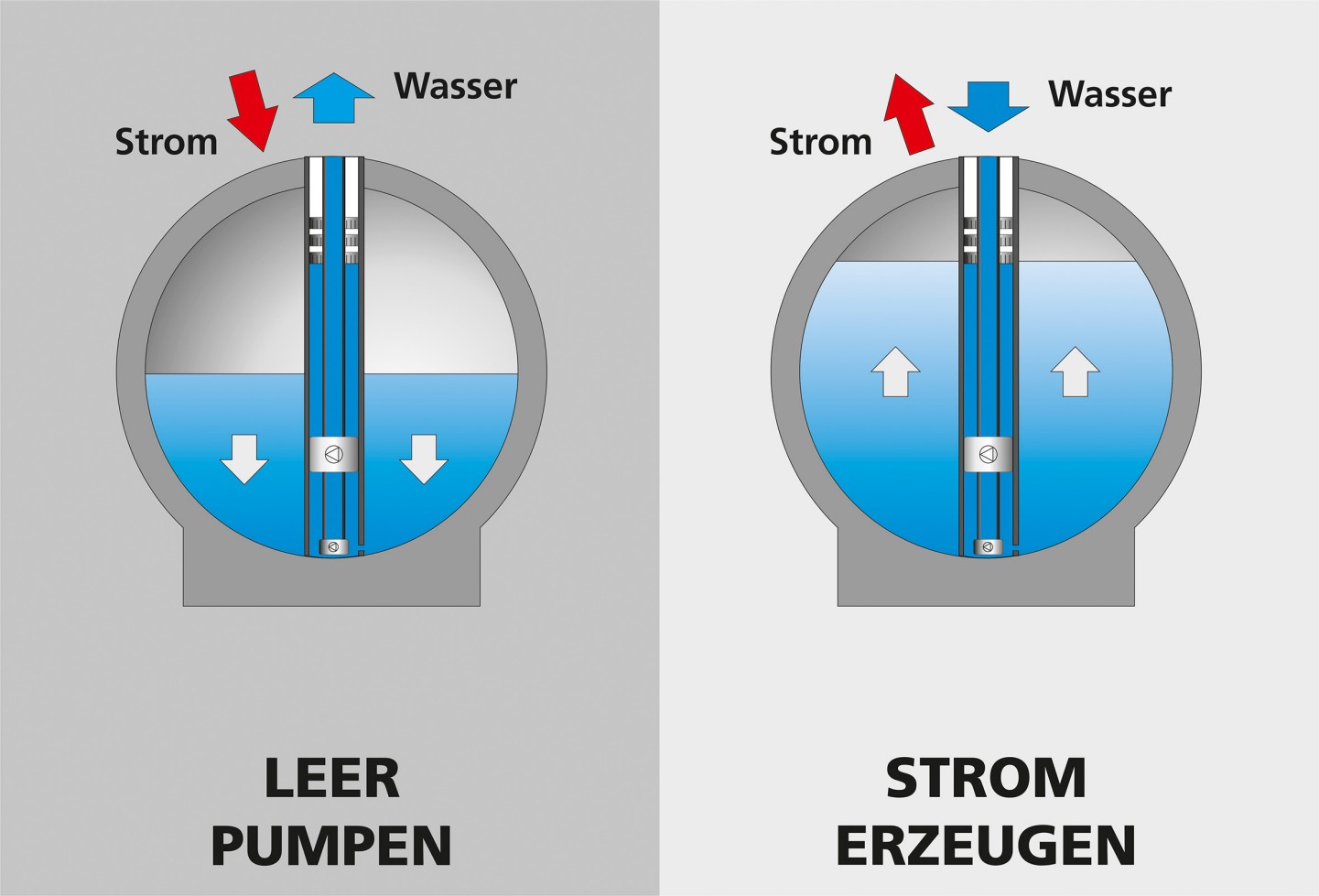
Marine pumped storage power plants are a novel approach to transferring the well-established concept of pumped storage systems to deep-sea environments. These offshore pumped storage systems are to be used in water depths between 600 m and 800 m and utilize the pressure in deep water to store energy. In contrast to conventional pumped storage power plants, the surrounding water serves as the upper reservoir, eliminating the need for complex piping. The storage capacity of the system is proportional to the volume and depth of the system.
The StEnSea system consists of a hollow concrete sphere that functions as the storage reservoir, and an inserted technical unit containing the pump turbine, a controllable valve, and the components for measurement, control, and regulation (MCR). The technical unit can be removed from the concrete sphere installed on the seabed, maintained or repaired on land, and then reinserted.
An empty sphere corresponds to a fully charged storage unit. To discharge the storage unit, the valve is opened and water can flow into the sphere through the pump turbine. The inflowing water drives the generator via the turbine, which feeds electricity into the grid. Charging is achieved by pumping the water out of the sphere against the surrounding water pressure using surplus energy.
Techno-Economic Assessment
Techno-Economic Assessment
The techno-economic assessment has shown that the costs of the StEnSea system are similar to those of conventional pumped storage plants. The construction of conventional pumped storage plants is hindered in many places by conflicts of use and the resulting impact on the landscape and local water balance. The conflict of use and the impact of the StEnSea technology on the environment are considered to be significantly lower, meaning that no major restrictions are expected in the selection of new locations.
Another advantage of the technology is its modular design. In a StEnSea park, any number of units can be interconnected to achieve different outputs and capacities. This increases the flexibility and scalability of the technology and thus the range of potential applications.
Leave a Reply