Do we have Free Will?
You get to choose
Last evening I was chatting with my son in law and he brought up the topic of free will. He said, that although he was conflicted, that it seemed to him that we do not have free will. I, of course disagreed.
However, he does have the support of many great philosophers and many modern thinkers and some quantum physicists agree with him:
Schopenhauer argued that while people have the physical freedom to act on their desires, they do not choose the desires themselves, which are driven by internal and external causes
- Spinoza stated that “human beings are mistaken in thinking they are free. This belief consists simply of their being conscious of their actions but ignorant of the causes by which they are determined.”
Now those of us who are older know that life is messy. So, during our chat I did partially agree with my son in law in this way: because we need to conform to social norms – or pay a very high price for not fitting in – many of our choices are severely limited. Secondly, I have to admit, that I do many things on “auto-pilot”. How many times have you driven out your driveway and turned in the direction you normally go, even though on that particular day you needed to turn the other way? Well, I for one have done just that often. It turns out that there is a paper which has finds that there is a biological foundation for this and is well explained in The Unbearable Automaticity of Being (Bargh & Chartrand 1999):
The authors conclude that various non-conscious mental systems perform the lion’s share of the self-regulatory burden, beneficently keeping the individual grounded in his or her current environment.
Even this partial agreement did not satisfy my son in law (he likes to win arguments). I suggested that in the “great man theory of history” it appears that so called “great men” (who usually slaughtered a lot of innocent people) made choices that matter. He replied that Alexander the Great and Napoleon did not believe that they had a choice but to attempt to conquer the world: they were driven to do so by a higher power. Mmmm…..
That is interesting but did not convince me. Here is another line of thinking in this debate that I use a test for many abstract questions that are more intellectually based than “reality” based. It seems to me that asking if we have free will is like asking “Is there life after death?”: there is no answer and it is unknowable because it is not testable. It is this unknowability which gives us a psychological “space” within which we can create free will. Now whether or not that imagined free will is “real” or not is once again unknowable as it is untestable
And how about this line of thought? Free will is our creation, it is a self fullfilling prophecy, It only exists if we believe it existsif we don’t believe it then it does not exist. In other words all we have is belief, beginning with a belief in self, an inner knowing that I matter, an inner knowing that I can change my life and the world around me. Does that mean there is certainty? Does that mean we can know and understand everything? Quite the contrary. Free will means we can revel in uncertainty & Not Knowing and be comfortable with the possibilities they create, and because these possibilities now exist we get to choose and thus have free will.
Perhaps free will is like music, just like “music is the space between the notes” free will only exists in the seemingly empty space when you are not busy, not over whelmed by information and obligation and so much change that it makes you so busy that you have no emotional and intellectual moments of “nothing”, no moment of just staring at the clouds and wondering… no space to allow creativity to come upon you and write a poem that consoles your soul…. Here is one that I wrote as I chose to not give up on a dear family member who is very ill. Did choosing to write this poem help stabilize my emotions? Absolutely!
Of course we have to end with the question: What are you going to do about this? How is this all relevant to the mission of saving us and the non-human world from the destruction we have unleashed. Perhaps part of the reason that we are having limited success changing our habits and economic systems is that people now “believe” in determinism, that they now “choose” that there is no free will, which is to me a contradiction because they are choosing to believe that they have no choice, because modern life is over whelming, too much of everything, and alone in a world that wants to destroy and kill you with no belonging and no meaning and no purpose…So, even if its only in your imagination, choosing to believe you have free will gives new possibilities that would not exist without it. For example, optimism is a choice, a very powerful choice that helps us overcome great odds.

So why does this matter? In the face of our destruction of our natural and social worlds there are many people who are just plain giving up. Most people are focussed on what is wrong instead of what is right. Many are becoming nihilists and see little meaning and purpose in life other than having a good time focussed on self. Well, determinists who think we have no free will indirectly pour gasoline on this attitude because “what will happen, will just happen, and there is nothing you can do about it”. My deep and profound reply:
Rubbish.
I leave you with one of my favourite provocative writers to leave you with the bit of uncertainty we all need to be truly free:
The strongest knowledge-that of the total unfreedom of the human will-is nonetheless the poorest in successes, for it always has the strongest opponent: human vanity.
-Nietzsche, Human, All Too Human
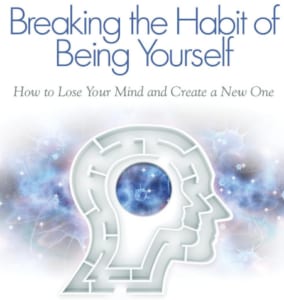
p.s. Here is fun book to read about creating the space in your life to actu allt exercise your free will and not be on auto-pilot: Breaking the habit of being yourself by Joe Dispenza.
Leave a Reply