The Wile E. Coyote Syndrome
We don’t React until its too late
When I was a kid a favourite show was the contest of wits between Road Runner and Wile E. Coyote. It was somehow terrific to see the Road Runner constantly outwit the Coyote – who, in turn, was impressive in that he never gave up. Who knew that profound wisdom was to be found in all this silliness? I get regular news feeds from Paul Krugman, the famous economist. Today’s piece on how Trump is destroying the political independence of the Federal Reserve focused on his observation that people in crowds don’t react to catastrophes until its too late. He did not explain the psychology behind that statement but given that he’s a smart guy I am sure he checked this observation of human nature out before writing it down. Of course it made me curious because we all recognize that the same dynamic is playing out with the ecological-social suicide of our culture – most of the crowd cannot admit its a catastrophe and when they do it will be too late. So, let’s explore this weird part of what makes us human so we can not be part of the mob but used the other, positive aspects of what makes us human: our ability to act before disasters happen and not only be stuck in reactive mode.

T his is what Paul Krugman, Nobel prize winning economist, wrote in his email today [Aug. 28/25]:
Trump’s campaign to take over monetary policy has shifted from a public pressure to personal intimidation of Fed officials: the attack on Cook [board member of the Federal Reserve] signals that Trump and his people will try to ruin the life of anyone who stands in his way. There is now a substantial chance that the Fed’s independence, its ability to manage the nation’s monetary policy on an objective, technocratic basis rather than as an instrument of the president’s political interests and personal whims, will soon be gone.
So why aren’t markets freaking out? Nations in which central banks lose their independence sooner or later suffer high inflation, especially when they are taken over by autocrats who buy into crackpot economic doctrines. My read of economic and financial history is that market pricing almost never takes into account the possibility of huge, disruptive events, even when the strong possibility of such events should be obvious. The usual pattern, instead, is one of market complacency until the last possible moment. That is, markets act as if everything is normal until it’s blindingly obvious that it isn’t.
The inimitable Nathan Tankus summarizes this by saying that the market is not, as stylized economic models would have us believe, a mechanism that pools the knowledge and informed judgment of millions of investors. It is, instead, a “conventional wisdom processor.” That is, it reflects views that seem safe to hold because many other people hold them — and the crowd only abandons those views when they become blatantly unsustainable.
John Maynard Keynes said something similar in Chapter 12 of his General Theory of Employment, Interest and Money. Market investors, he argued, pay little attention to the question of what assets are truly worth. Instead, they worry mostly about the market value of those assets a few months in the future. In a memorable albeit sexist passage (it was 1936), he declared that:
professional investment may be likened to those newspaper competitions in which the competitors have to pick out the six prettiest faces from a hundred photographs, the prize being awarded to the competitor whose choice most nearly corresponds to the average preferences of the competitors as a whole; so that each competitor has to pick, not those faces which he himself finds prettiest, but those which he thinks likeliest to catch the fancy of the other competitors, all of whom are looking at the problem from the same point of view … we devote our intelligences to anticipating what average opinion expects the average opinion to be.
So if the conventional wisdom is that economic conditions will remain more or less normal despite highly abnormal policy, markets will remain calm until the illusion of normality becomes unsustainable. At that point market prices may “change violently.” The current technical term for this phenomenon is a
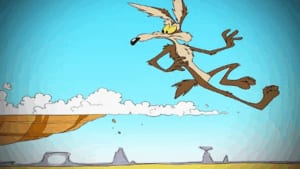
“Wile E. Coyote moment” — the moment when the cartoon character, having run several steps off the edge of a cliff, looks down and realizes that there’s nothing supporting him. Only then, according to the laws of cartoon physics, does he fall.
You might ask why smart investors with long time horizons don’t foresee Wile E. Coyote moments and get very rich in the process. Some do. But for reasons that would take another long post to explain — maybe a primer one of these days — there never seem to be enough such investors to shake market complacency, no matter how unwarranted. It’s one thing to short a stock, but to short the entire market is a completely different beast. All of which says, in turn, that the absence of a strong reaction to Trump’s assault on the Fed isn’t a sign that everything is OK. We are, in fact, looking at a policy disaster in the making. But markets probably won’t react strongly until the disaster is already upon us.
So there you have it – Krugman’s take on the Wile E. Coyote syndrome. He sees this syndrome as Group think acting in such a way that the group cannot possibly admit that normal has gone out the window and that violent change is upon us. The gravity takes over and we all fall off the cliff.
The psychology he discusses confirms what i have seen life. Its another way of saying:
If you run with the wolves you must howl with the wolves –
or else they will rip you to shreds because the pack will consider you to be the enemy.
Of course this successful strategy stops working if the wolf pack is running towards a hunter with a fast loading rifle. Then the smart wolf [you and I] – after seeing a comrades go down -turns tail and runs away. Sometimes in life its better to be seen as a the odd man out so you can live for another day, as Shakespeare’s character Falstaff knew well when he said:
Discretion is the better part of valour
So far so good. All is well. We’ve solve the world’s problems. All we have to do is stop being like Wile E. Coy0te and stop running BEFORE the cliff instead of AFTER. Simply, right? Not! Why not? Because when I kept researching Wile E. Coyote I came across a myriad of syndromes all named after our hero. In other words, the defects of our hero the coyote – meaning of course, us – are many. Here are a few:
The Wile E. Coyote syndrome. You see, we all want about the same things. Peace, safety for our families, happiness and the like. Others are chasing after a higher position, fame, more money, fast cars, relationships and on and on. Like Wile E. Coyote, they never catch what they are continually chasing after. Chasing after the things of the world will not bring satisfaction. Chasing the things of the world will bring heartache. Chasing after the things of the world will bring disillusion.
OR
The basic gist is that if we spend all of our effort chasing the wrong, or insufficient, goals then the attaining of them will be our own undoing. If Wile E. every caught the Road Runner, what would he do next? What would he become? The wrong goals inevitably lead us into the wrong roles.
OR
“Have you ever noticed the paradox that you seem to accomplish far more and work with far greater mental clarity when you don’t ‘try’ too hard? That is, when you don’t place too much emphasis on the ‘importance’ of what you’re doing or what you’re trying to achieve. That’s because the sense of pressure [urgency] that often accompanies ‘importance’ expends a great deal of negative mental energy–energy that could have otherwise been put to positive use.
“Remove that pressure and instead of being consumed with stress, urgency and insecurity, you’re filled with enthusiasm, interest, curiosity and creativity–resourceful mental states that are only accessible when you’re relaxed and calm.”
OR
Wile E. Coyote has that special X-Factor that most Inventors lack. Wile E. Coyote has the drive to get back up and try again and again and again, no matter the odds, no matter the obstacles.
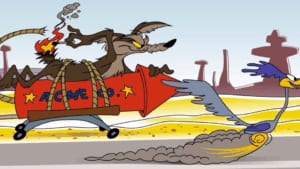
Here is a character that has been blown up, smashed, electrocuted, run over by a train, a truck, a steam roller, cut in half, set on fire, fallen from every known height, been shot out of a cannon, clung to a speeding rocket sled, tied rockets to his back, his shoes, and faced countless other dangers all to attain his one single goal, catching the Road Runner. Most Inventors stop at the very first road block they hit or rejection letter they receive and give up. Not Wile E. Coyote. When one attempt doesn’t work out as planned he pulls himself together, dusts himself off and is back at the drawing board thinking about his next plan of attack. He is always coming up with a new method to meet the same goal. This is a major lesson for Inventors. If you hit a wall, or get a rejection, stop, evaluate why you hit the wall, what are your options, devise a new strategy and move on. Learn from your mistakes and seek a better way to get to the goal you are wanting.
You get the picture. Wile E. Coyote is so very human. So wonderful, so heroic, so determined and so flawed – just like all of us. So what can you do with all these version of the Wile E. Coyote syndrome? I don’t know – you choose. Choose the syndrome that best matches your personality and your life challenges. They’re all valid – like the various cuts of a diamond that work together to make the light sparkle – all of true – when put together.

Now many of you may feel this is an unsatisfactory conclusion – and I agree. So let’s leave with what I hope is some satisfaction – the Indigenous version of Coyote. Coyote is the Trickster. Coyote is the fun loving, irrascable fool who like Falstaff makes us laugh at ourselves and yet, within that tom foolery, brings us a hint of wisdom. Coyote brings is freedom – and chaos, pain – and excitement. Anything is possible for Coyote – the good and the bad, the divine and the sensuous. Coyote is life in all its guises. The great part is that we get to play with Coyote all our life long. If we keep playing with the random beauty of all that Life has to offer, perhaps, perhaps, we can survive the fall off the cliff, because over the cliff we are going. All we have to do is pick ourselves off when we hit the bottom, learn a lesson or two, and do things a bit differently than last time. And one day, one day soon, we will catch the Road Runner! Or not: perhaps stopping our chase for success and domination and control so that we can become friends with Road Runner – who may be Life itself – is what we need to do. But that is only one possibility. Who or what is the Road Runner really? I guess we’ll only know when we catch him but rest assured all our striving and running to catch up and be more and be better will metamorphose into something new – a new culture, a new way of being. We won’t be Wile E. Coyote of Disney fame but more like Coyote the Trickster – a being connected to all life and all being – and that day is a day I am looking forward to.
Leave a Reply