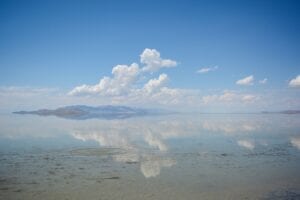
 Climate change and rapid population growth are shrinking the lake, creating a bowl of toxic dust that could poison the air around Salt Lake City.
If the Great Salt Lake, which has already shrunk by two-thirds, continues to dry up, here’s what’s in store:
The lake’s flies and brine shrimp would die off — scientists warn it could start as soon as this summer — threatening the 10 million migratory birds that stop at the lake annually to feed on the tiny creatures. Ski conditions at the resorts above Salt Lake City, a vital source of revenue, would deteriorate. The lucrative extraction of magnesium and other minerals from the lake could stop.
Most alarming, the air surrounding Salt Lake City would occasionally turn poisonous. The lake bed contains high levels of arsenic and as more of it becomes exposed, wind storms carry that arsenic into the lungs of nearby residents, who make up three-quarters of Utah’s population.
“We have this potential environmental nuclear bomb that’s going to go off if we don’t take some pretty dramatic action,” said Joel Ferry, a Republican state lawmaker and rancher who lives on the north side of the lake.
As climate change continues to cause record-breaking drought, there are no easy solutions. Saving the Great Salt Lake would require letting more snowmelt from the mountains flow to the lake, which means less water for residents and farmers. That would threaten the region’s breakneck population growth and high-value agriculture — something state leaders seem reluctant to do.
Utah’s dilemma raises a core question as the country heats up: How quickly are Americans willing to adapt to the effects of climate change, even as those effects become urgent, obvious, and potentially catastrophic?
The stakes are alarmingly high, according to Timothy D. Hawkes, a Republican lawmaker who wants more aggressive action. Otherwise, he said, the Great Salt Lake risks the same fate as California’s Owens Lake, which went dry decades ago, producing the worst levels of dust pollution in the United States and helping to turn the nearby community into a veritable ghost town.
“It’s not just fear-mongering,” he said of the lake vanishing. “It can actually happen.”
A modern oasis, under threat
Say you climbed into a car at the edge of the Pacific and started driving east, tracing a line across the middle of the United States. After crossing the Klamath and Cascade mountains in Northern California, green and lush, you would reach the Great Basin Desert of Nevada and western Utah. In one of the driest parts of America, the landscape is a brown so pale, it’s almost gray.
But keep going east, and just shy of Wyoming you would find a modern oasis: a narrow strip of green, stretching some 100 miles from north to south, home to an uninterrupted metropolis beneath snow-capped mountains, sheltered under maple and pear trees. At the edge of that oasis, between the city and the desert, is the Great Salt Lake.
Utahns call that metropolis the Wasatch Front, after the 12,000-foot Wasatch Range above it. Extending roughly from Provo in the south to Brigham City in the north, with Salt Lake City at its center, it’s one of the fastest-growing urban areas in America — home to 2.5 million people, drawn by the natural beauty and relatively modest cost of living.
That megacity is possible because of a minor hydrological miracle. Snow that falls in the mountains just east of Salt Lake City feeds three rivers — the Jordan, Weber, and Bear — which provide water for the cities and towns of the Wasatch Front, as well as the rich cropland nearby, before flowing into the Great Salt Lake.
Leave a Reply