What is Good Enough Canada?
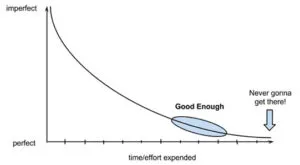
We now rank 40th in fraction of our population that has received a vaccination as less than 3% of the population has been inoculated with at least 1 shot while Israel has vaccinated 60% of its population. Does this matter? Oh yes, in many ways. But in this writing I don’t want to focus on the impacts of our less than stellar results but rather on the mindset that got us where we are. I call this mindset: “It’s good enough.” Or “Canada is ranked among the best place in the world to live so I guess that means we are doing a great job at how we run thing.” In other words – we are complacent.
This does not mean I recommend perfectionism…except when it is absolutely necessary. It does mean I recommend being sloppy…except when being sloppy is actually sensible. What I want to try to say is that the quality and quantity of the effort depends upon the task and motivation at hand. In other words, “good enough” is a moving target. In the case of Covid-19 it is clear that our sloppy definition of “good enough” is not cutting it. Are we capable of better? Of course! Yet somehow we have allowed a country that was one of the first creators and producers of vaccines, the country that invented the smart phone, the country that once had the world’s 3rd largest navy [ we now can barely get together 23 ships – and NO large ships like destroyers] to slip from being the envy of the world to just another normal country which does not quite have its SH—together.
“In 2017, Canada’s last destroyer, HMCS Athabaskan, retired, forcing the Royal Canadian Navy to lean on the U.S. to protect its ships from air attack. Canada’s entire naval strength is less than a single overseas U.S. Navy base ”

If you enjoy being depressed read this McLean’s article: “The sinking of the Canadian Navy
A maritime nation has let its naval fleet fall apart. Here’s how a once-proud force fell into such an embarrassing state of disrepair” https://www.macleans.ca/news/canada/the-sinking-of-the-canadian-navy/
Is this “good enough”? I could go one but I think you can see that our results in fighting Covid-19, a kind of proxy war, are actually rather typical of our mediocrity. Am I being a tad harsh? Yes – to make a point – to get us out of mood of complacency that we so love to wallow in. Really, it’s cultural psychology. The following excerpt from Psychology Today makes my point effectively: there are times that our Canadian moderation is appropriate, and times that demand perfection. We live in such times Canada. As they used to say in the military; Shape up or Ship out!
How Do You Know What’s Good Enough?
How can you tell whether something you’ve done is good enough? Or just what would make it good enough for you? Doubtless, personal standards come into play here. But where exactly do such standards originate? Is it possible you unwittingly internalized your parents’ unrealistically high requirements of you as a child? Or are your “good enough” criteria authentically aligned with your deepest beliefs, values, and ideals? And finally, how about situations that actually demand your performance be perfect? Under three distinct headings, this post will attempt to illuminate what being good enough—or doing something well enough—involves, or ought to involve. The first category takes up what you feel you must do perfectly, even in cases where it’s hardly called for or reasonable. The second considers what you may be obliged to do perfectly, independent of whether you feel like doing it or experience it as gratifying. And the third division is what you freely choose to execute at a level much higher than necessary because it affords you genuine satisfaction, pleasure, and joy. Or you’ve decided that doing it helps pave the way toward self-fulfillment. To put it more simply, the three categories are distinguishable in terms of compulsion, obligation, and choice. Described below are the three essential classifications of “good enough”:
- The curse of perfectionism. Perfectionism is about doing things, or struggling to do things, in accordance with the loftiest of standards. And these standards, frankly, make very little logical sense. In a wide variety of situations, they compel you to put considerably more effort into tasks than is rationally justified. So you end up squandering your resources. For driven to do things perfectly leads you to manage your time and energy poorly. You might, for instance, spend many hours refining a report for your boss, even though by now it meets all his criteria for acceptability. And you may miss important deadlines (and eventually get fired) because you just can’t stop working on something that’s already good enough.
If you can’t tolerate making the slightest mistake, if you constantly focus on negatives and strive to eliminate each and every one of them—or if you set your goals so high that you almost never feel capable of reaching them—then you’re afflicted with the self-defeating malady of perfectionism. And an additional problem caused by such a dysfunctional mode of functioning involves a strong tendency to procrastinate. For you’ll hesitate tackling anything you fear you won’t be able to do perfectly. Endlessly obsessing about doing things just right, your neurotically distorted perspective leads you to lose sight of critical matters regarding such things as timing, appropriateness, and efficiency.
So, where does such counter-productive—yet intensely driven—behavior come from? My experience as a psychologist for 30+ years strongly suggests that it’s “learned behavior,” compelled by all sorts of negative messages about self received while growing up with overly critical caretakers. Their message would have been that for you to be seen as “good enough,” and therefore deserving of their commendation and support, you had to do everything superlatively. Having parents that either withheld positive feedback unless your performance was exemplary or, in fact, never offered you approval (no matter what the quality of your performance) typically suggests one of two things. Either they didn’t have it in them to do so because of their own parents’ deficiencies in this regard or, not having received such recognition or approval from their overcritical parents, to even think of offering you what they themselves were deprived of would open up the floodgates of their never- resolved emotional pain, bringing up feelings of hurt and vulnerability they still lack the resources to face.
Here are two (admittedly extreme) instances of what I have in mind—taken, sadly, from so many examples I’ve been provided with by past therapy clients. In one instance, a client shared how as a high school student she eagerly approached her (super-critical) father to share with him her latest report card, which revealed that of the five classes she’d just completed she received four A’s and one A-. Her father’s response? He put his finger directly on the minus sign and said gruffly, “What’s that doing there?” I hardly need mention how crestfallen and hurt she was by this grossly insensitive remark, hastily retreating to her bedroom in tears. A second example is even more blatant as regards a parent’s stubborn refusal to validate their child’s worth. In elementary school, this client proudly brought home a report of all A’s. Her mother (who, I should add, was later institutionalized!) brutally beat her, stridently yelling at her and declaring that she must have cheated since she clearly wasn’t smart enough to get such high grades.
Get the picture? The habit of perfectionism can easily come from a child’s repeatedly receiving the message that being good enough—or even much better than average—really isn’t good enough at all.That nothing short of perfection will suffice to win the parent’s approbation and thus secure for them their urgently needed, but ever elusive, familial bond. Parental approval is extremely important to a child. So it’s certainly understandable that, unless they have it in them to rebel against their caretakers’ unreasonable dictates (and probably be left with chronic anger issues), they’ll eventually conclude that being adequate—for them at least—isn’t adequate. This is especially true if they were regularly inundated with such hypercritical messages very early in their development.
- The Prerequisite of Perfection. There are certain things in life that literally demand perfection. If you’re a brain surgeon, the slightest failure at absolute precision could have catastrophic consequences for the patient. If you’re building a house (even something as simple as a log cabin), should your measurements be only marginally off, the whole structure might end up so out of alignment that it eventually comes tumbling down. If you’re an accountant and accidentally overlook a single detail in preparing a client’s tax return, that individual might wind up being audited (and leave you with one less client!). And so on.
In short, what might be good enough in most areas might not be good enough in others—not, at least, where nothing short of faultlessness, or flawlessness, will do. Generally, people who enter fields where 100 percent accuracy is de rigeur have a penchant for precision anyway. But anyone else would feel enormously frustrated in having routinely to adhere to such perfectionist standards. For here there’s no margin for error, no possible wiggle room, when what needs to be done must be done “just so” or it could put someone, or something, at serious risk.
This is why, in contrasting perfectionism with behavior good enough for the job at hand, it’s critical to add the caveat I’m describing. Although almost all the literature on perfectionism rightly conveys a strongly negative bias toward it, it’s yet essential to point out that “good enough” simply isn’t good enough in certain circumstances. So in evaluating how well you might be required to do something—or even whether you’re adequately qualified to do it—you need first to carefully assess just how good in this or that case “good enough” really is.
- The Selection of Perfection. There are times when you might consciously choose to transcend “good enough,” to strive (discriminately!) toward perfection. Let’s say you’d like to do something much better than what would be, well, “perfectly adequate.” In such instances,you might be in the process of completing something acceptably—whether it’s writing a “thank you” note, letter, or report; teaching yourself a foreign language or a musical instrument; practicing your skills for a recreational game of tennis or softball; setting up decorations for a party; or any task or project you might be engaged in. For any number of reasons, you’re inclined to go considerably further—genuinely desiring to learn something, or make something, “just right.”
What I wish to suggest here is that—for the sheer challenge, or maybe even joy of it—doing something far better than necessary may be intrinsically satisfying to you. I might use as an example my own predilections as a blogger for Psychology Today. Even after I think I’ve made a post “good enough”—that is, it’s reasonably clear and coherent, and I’ve included all the points I had in mind—I’ll continue to work on it. For I’m motivated to make each sentence as lucid, cogent, and forceful as I can. Why? Simply because of the pure pleasure and satisfaction I derive from endeavoring to get my piece “just right” (at least, as much as I’m able to get it!). My keen desire to share my knowledge and point of view with others, and in the most helpful, comprehensible way possible, reflects something intrinsic to my core values. That is, it really matters to me. Another way of saying this is that my writing is an expression of my passion to disseminate whatever hard-won insights I may have achieved through many years of clinical practice and professional contemplation. So I can’t resist—nor do I want to resist—giving each of my posts as much time and consideration as required to make it as persuasive as possible. Doubtless, such concentrated attention takes away from the time I might devote to other pursuits. But it yet affords my life a balance—or creative outlet—that, personally, feels just about ideal. And regarding my writing as a welcome intellectual challenge, I’m grateful to have the opportunity to influence vastly more people (currently, my 200 or so posts have garnered close to 4 million views) than the limited number of individuals I can work with professionally. Additionally, I think all the thought and research I put into my writing actually enhance my therapeutic effectiveness. I believe that there are many things in life we’d work harder at if we deemed that doing so would afford us with a truly gratifying, joyful, or even jubilant, experience. And it’s precisely when we’re willing to rouse ourselves and aspire to do something that just might turn out exceptional—when, that is, we labor to transcend mere adequacy and strive to accomplish something affirming the very best in us—that we can genuinely perceive ourselves as “special.” And in a way that virtually all of us yearn to feel. Such striving may well deprive us of immediate gratifications elsewhere, but we’re still very likely to regard such “sacrifices” as eminently worth it. https://www.psychologytoday.com/ca/blog/evolution-the-self/201310/how-do-you-know-whats-good-enough
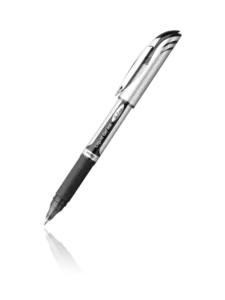
So, what can you do about this? Not accept “good enough” when the situation demands more. Obviously avoid the paranoia of perfectionism, but recognize that sometimes striving for the perfect is the right and healthy way to go. I leave you now to do some writing, the old fashioned way, with a pen. Before me are two pens, one a typical American BIC ball point pen and other a Japanese liquid gel pen which glides like sharp skates on perfect ice – it is a joy to write with. Guess which I will choose to use? So, Canada, I wish you all the best as we not only demand more of our leaders but more importantly demand more of ourselves.
Leave a Reply