More charging sites mean that electric trucks can extend their range and do more daily routes, boosting e-freight economics in the face of Trump administration headwinds.
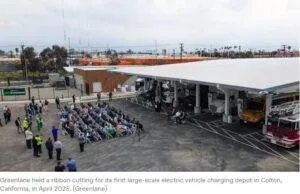 It’s a tough time for electric trucking in the U.S. The Trump administration has cut off funding for heavy-duty vehicle charging and port infrastructure. Republicans in Congress are trying to rescind states’ authority to set clean vehicle mandates. And tariffs are throttling incoming cargoes to U.S. ports, hampering the business of trucking as a whole while likely also driving up the already-high price of battery-powered trucks.
But in Southern California, the transition away from diesel trucks, which emit a disproportionate share of the transportation sector’s planet-warming and health-harming emissions, is moving forward despite federal policy obstacles. Two big all-electric charging depots opened in April to serve clean trucks operating in the region, which is home to the busiest seaport complex in the country and is the epicenter of U.S. electric truck adoption.
The first, located in Rancho Dominguez, 12 miles north of the ports of Los Angeles and Long Beach, is owned and operated by Terawatt Infrastructure, a startup with more than $1 billion in capital and that is working with a consortium of companies including Ikea, Maersk, Microsoft, and PepsiCo. With 7 megawatts of capacity at 20 fast-charging stalls, it can charge up to 125 trucks per day.
The second site is in Colton, a city about 60 miles east of Los Angeles in California’s Inland Empire, a region crowded with massive distribution warehouses. That site is owned and operated by Greenlane, a more than $650 million joint venture of Daimler Truck North America, utility NextEra Energy, and investment firm BlackRock Alternatives. It has 12 pull-through sites for trucks hauling trailers, which are equipped with 400-kilowatt dual-port chargers, along with 29 “bobtail” lanes — sites for trucks without attached trailers — equipped with 180-kW chargers. In total, it can support just over 10 megawatts of charging.
These facilities are the latest in a line of big truck-charging depots springing up across California, built by major firms like Amazon and PepsiCo, freight companies such as NFI Industries and Schneider National, logistics operators like Prologis, and startups including Forum Mobility, Voltera, and WattEV. This proliferation is in response to the state’s ambitious truck electrification goals, which include a target for completely zero-emissions fleets by 2045, and to the the hefty incentives it has put in place to accomplish that.
Terawatt’s and Greenlane’s newly opened electric truck stops represent a new class of charging site meant to serve the next phase in the Southern California electric truck charging evolution.
Early truck-charging sites were designed to serve shorter-range trucks that deliver goods from a central warehouse before returning to recharge overnight. But Terawatt’s and Greenlane’s new depots are meant to function more like a classic highway stop for battery-powered trucks looking to deliver goods hundreds of miles away.
New charging depots help SoCal’s electric trucks go… | Canary Media
Leave a Reply