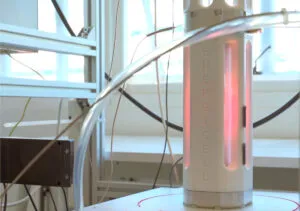
 ENG8 has developed the EnergiCell, a scalable, solid‑state Low‑Energy Nuclear Reaction (LENR) system designed to provide continuous, decentralized thermal and electrical power. Unlike conventional fusion, which demands extreme temperatures and pressures, the EnergiCell employs a catalyzed fusion process that operates under comparatively moderate conditions. The system is engineered for 24/7 on‑demand output with no emissions and targets capital costs at roughly half those of wind or solar installations, while offering operating costs comparable to hydrocarbon generator sets—but without fuel consumption.
The EnergiCell architecture comprises two main elements. The EnergiCell reactor is where LENR energy release occurs, while a dedicated support system maintains the environment required for direct energy conversion and continuous operation. The process uses ionized H₂O as its fuel source to supply hydrogen ions for catalyzed fusion, forming new atomic nuclei and releasing energy as heat and electricity. System configurations can also be adapted to produce hydrogen and oxygen, enabling chemical energy storage and additional fuel applications.
ENG8 reports that its proprietary, patent‑protected methods yield energy releases that significantly exceed the electrical input needed to sustain plasma formation. Tests and demonstrations indicate a fusion energy gain factor (Q) greater than 3, with EnergiCells achieving self‑powering behavior that supports net export of both electrical and thermal energy. Beyond direct power and heat, the system can produce chemical energy carriers including HHO, hydrogen, and oxygen.
Multiple third‑party evaluations have assessed EnergiCell’s performance and reported energy outputs well beyond conventional chemical reactions. Building on these validations, ENG8 is developing next‑generation EnergiCells targeting 100–200 kW of continuous, self‑sustaining power. The company positions the system for diverse applications, including industrial and off‑grid generation, commercial heating and process energy, electric transportation infrastructure, and hydrogen/oxygen production for storage and fuel. In contrast to variable renewables like wind and solar, EnergiCell aims to deliver consistent, on‑demand power without large‑scale storage, making it a candidate replacement for hydrocarbon generator sets and backup systems.
Leave a Reply