Perhaps what we call Impossible is only very, Very, VERY Highly Improbable
When you have eliminated the impossible, whatever remains, however improbable, must be the truth Sherlock Holmes
A few days ago at the cottage I was playing a fun Dutch board game called Rummikub with a friend who had never played the game before. You need to objective of the game before I explain how this event makes clear the difference between the impossible and the VERY highly improbable. When a player has a turn he/she must either put down a number or pick one up as the game’s objective is simply to get rid of all your numbers by adding them to a sequence of either 3 or more numbers in a row of the same colour or 3 numbers of the same value but being a different colour. Here the fun part: you can add your numbers to other people’s sequences already on the table. The picture below is my friend’s board – he was losing badly. In fact, I was only 2 numbers away from winning and based upon a move another person made I was just about to win the game: after my friend had his turn. I was confident that I would win. I was certain of it. It felt impossible that I could lose.
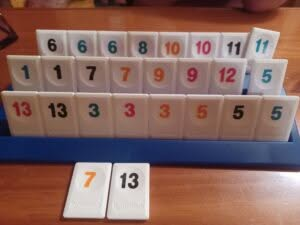
Well, the quantum universe did what it is prone to do: make the seemingly impossible – what I call the VERY Highly Improbable – happen. He picked up exactly the right number to exit the game in 1 turn by adding this pieces onto other people sequences and won the game by getting rid of ALL his number all in 1 turn! This is a VERY Highly Improbable event – but it happened – and now that I am noticing these kind of events I notice them happening quite often.

People easily believe in the impossible but refuse to believe in the improbable – Oscar Wilde
I don’t want to get into personal examples of these VERY Highly Improbable events but I do want to make the point that our weird brains seem to lack the imagination the imagine the highly improbable as eventually likely while simultaneously living our lives based upon ideas that totally impossible. In other words Oscar Wilde’s quote accurately describes human nature as I have seen it. Why is this?
We all believe in something: it could be science and reason or art and beauty: what we believe in gives meaning and purpose and direction to our lives and is thus essential to our survival. There are people who believe Bigfoot exists, or the curse of a broken mirror, or that this group or action caused a natural disaster. From ghosts to all kinds of monsters, despite no evidence supporting their existence, we believe. Who Has False Beliefs? We all do. Whether it was something we were “taught” as children, to beliefs we developed through experience, we each hold on to false beliefs. Yet here is something odd: studies have shown that people who have and practice a religious belief are less likely to believe in the supernatural. [1] Psychology informs us that we love the impossible because it solves our problem of our need to understand cause – effect in the simplist possible way: magical thinking – because that’s what believing in the impossible is: avoiding the tough work of finding real cause-effect linkages that require hard intellectual work. It’s quite simply takes less work and energy to believe that the impossible happens than to work at finding the cause-effect link that makes the possible possible.
Clearly understand the improbable is a different story. Wilde asserts that we are inherently skeptical when faced with the improbable. This implies that there is a distinction between the two: the impossible being something that is beyond the realm of what is physically or logically feasible, and the improbable suggesting something that is unlikely but potentially within the realm of possibility. By entertaining the impossible, we can disengage from the constraints of our rational minds and freely explore realms of imagination and creativity. We find solace in the idea that the impossible can exist precisely because it is beyond the limits of our everyday experiences. This embracing of the impossible allows us to tap into the wellspring of human creativity, unlocking new ideas, inventions, and artistic ventures that push the boundaries of what is deemed possible.On the other hand, the improbable challenges our innate cognitive frameworks, forcing us to confront the limitations of our understanding. The improbable operates within the confines of what we perceive as the realm of possibility, making us question our ability to discern between what is probable and what is not. In this sense, our skepticism towards the improbable arises from our deep-rooted desire to grasp the predictable and make sense of the world around us. [2]
This brings me to our seemingly impossible modern challenge: how do we stop killing ourselves and other species as we do so? I know we can do it – if we really wanted to; if we really believed that we are killing ourselves. It seems that most of us simply lack the imagination to see that this is really happening. Most of us think is so improbable that we could kill either our civilization or humanity itself because they don’t want to put in the hard intellectual work to make the cause-effect links which demonstrate that is possible. Rather, they choose the magical thinking route – which is must easier- and simply wave their hands in the air and say “its impossible!”. Yup – these are the folks who may also be flat earthers or think “Elvis lives!”. But the fact is, our brains are also designed to choose the easier route in thinking because thinking requires so much energy. Sticking to what psychologists call False Beliefs is so common because evolution adapted to be that way in a world which did not change much. At some point we adopt a belief system that keeps us alive. That’s good. When we were cave men that worked because the world did not change. Now we do the same thing. Oops! Our belief system no longer works -the world changed so we are now stuck with a maladaptive false belief – and we don’t change because its too hard to change.
So there you have it. Proof that it is possible for us not to kill ourselves, if only we embrace the improbable, only if we have the imagination to create what does not yet exists, only if we have the vision to look ahead and know that it is our out dated past imagination which made the mess the world is in – but did so to make things better – but this old imagination is now a false belief – and must change – or we die. It’s that simple. Imagine. Belief that the very, Very, VERY Highly Improbable is absolutely possible – when we make it happen.
References
1. https://lynettemburrows.com/why-we-believe-in-the-impossible/
Leave a Reply